
At the heart of Traditional Chinese Medicine (TCM) lies the Five Elements Theory—an ancient wisdom that maps the interconnectedness of nature, the universe, and the human body. Dating back over 2,000 years, this theory classifies all phenomena into five fundamental elements: Wood, Fire, Earth, Metal, and Water. At TCM Oxford, we integrate this holistic framework into our acupuncture and Tuina massage therapies, helping patients restore balance by aligning their body’s energy with the natural cycles of the elements.
Each element embodies unique qualities, corresponds to specific organs, emotions, seasons, and even tastes—and they interact in two key cycles that sustain harmony: generation and restriction. The generation cycle (Wood feeds Fire, Fire creates Earth, Earth bears Metal, Metal condenses Water, Water nourishes Wood) represents mutual nourishment, while the restriction cycle (Wood controls Earth, Earth absorbs Water, Water extinguishes Fire, Fire melts Metal, Metal cuts Wood) prevents any element from becoming excessive. When these cycles function smoothly, the body’s Qi and Blood flow freely; when disrupted, imbalance and discomfort arise.
Let’s explore the five elements and their connections to human health, as we apply them in our Oxford clinic:
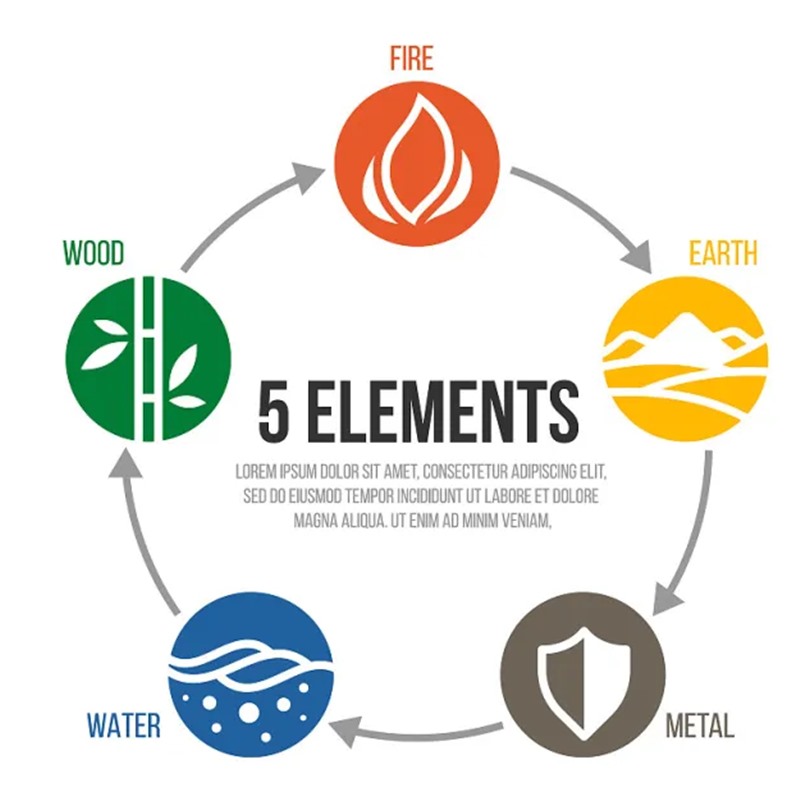 Wood (Mu): Linked to spring, growth, and flexibility, Wood corresponds to the Liver and Gallbladder, as well as the emotion of anger. A balanced Wood element supports smooth Qi flow and emotional stability; imbalance may manifest as irritability, mood swings, menstrual irregularities, or shoulder and neck tension. Our acupuncture targets points like LR3 (Taichong) to soothe Liver Qi, while Tuina uses gentle stretching and kneading techniques to release stagnation—restoring Wood’s natural vitality.
Fire (Huo): Associated with summer, warmth, and passion, Fire governs the Heart and Small Intestine, and is tied to joy. A healthy Fire element promotes mental clarity, a strong heartbeat, and emotional warmth; excess Fire may lead to insomnia, anxiety, palpitations, or mouth ulcers, while Fire deficiency can cause fatigue and cold hands. Acupuncture at HT7 (Shenmen) calms excess Fire, and gentle Tuina strokes on the chest and upper back nourish Heart Qi, balancing this fiery energy.
Earth (Tu): Representing late summer, stability, and nourishment, Earth corresponds to the Spleen and Stomach, and the emotion of worry. Earth governs digestion and nutrient absorption—imbalance often shows up as bloating, indigestion, fatigue, or excessive overthinking. We use acupuncture at SP6 (Sanyinjiao) to strengthen Spleen Qi, and Tuina’s circular abdominal strokes to improve digestion, grounding the body’s energy like fertile Earth.
Metal (Jin): Connected to autumn, clarity, and contraction, Metal rules the Lungs and Large Intestine, and is linked to grief. A balanced Metal element supports strong immunity and efficient elimination; imbalance may cause frequent colds, coughs, dry skin, or feelings of sadness. Acupuncture at LU9 (Taiyuan) tonifies Lung Qi, while Tuina techniques on the back and chest enhance respiratory function—honoring Metal’s role as the body’s protective barrier.
Water (Shui): Associated with winter, stillness, and renewal, Water governs the Kidneys and Bladder, and the emotion of fear. Water is the foundation of all bodily fluids and vitality; imbalance can lead to fatigue, lower back pain, poor memory, or urinary issues. Our acupuncture at KI3 (Taixi) nourishes Kidney Yin and Yang, and Tuina’s deep pressing techniques on the lower back strengthen Water energy—supporting the body’s natural healing and renewal.
In modern life, factors like stress, seasonal changes, poor diet, and sedentary habits often disrupt the five elements’ balance. At TCM Oxford, our qualified practitioners first diagnose which elements are imbalanced—using TCM’s four diagnostic methods (observation, listening, questioning, palpation)—then tailor acupuncture and Tuina treatments to reharmonize the cycles. For example, a patient with Wood stagnation (irritability + neck tension) may receive Liver-meridian acupuncture paired with Tuina to release tight muscles, while someone with Earth deficiency (digestive issues + fatigue) gets Spleen-tonifying treatments and dietary guidance.
Beyond clinical therapies, we guide patients to align with the elements through daily habits—embracing TCM’s preventive philosophy. This includes seasonal eating (e.g., warming foods for winter/Water, fresh greens for spring/Wood), emotional regulation (managing anger for Wood, grief for Metal), and seasonal exercise (gentle walking in autumn/Metal, stretching in spring/Wood).
The Five Elements Theory is more than a diagnostic tool—it’s a way of understanding that we are part of nature’s cycles, not separate from them. At TCM Oxford, we honor this wisdom by treating the whole person, not just symptoms, and empowering patients to maintain balance long-term. Whether you’re struggling with chronic pain, digestive issues, mood disorders, or fatigue, the Five Elements Theory offers a roadmap to holistic healing.
Discover how balancing the five elements can transform your health. Book a consultation with TCM Oxford today, and let our acupuncture and Tuina therapies guide you back to harmony with nature’s timeless rhythm.